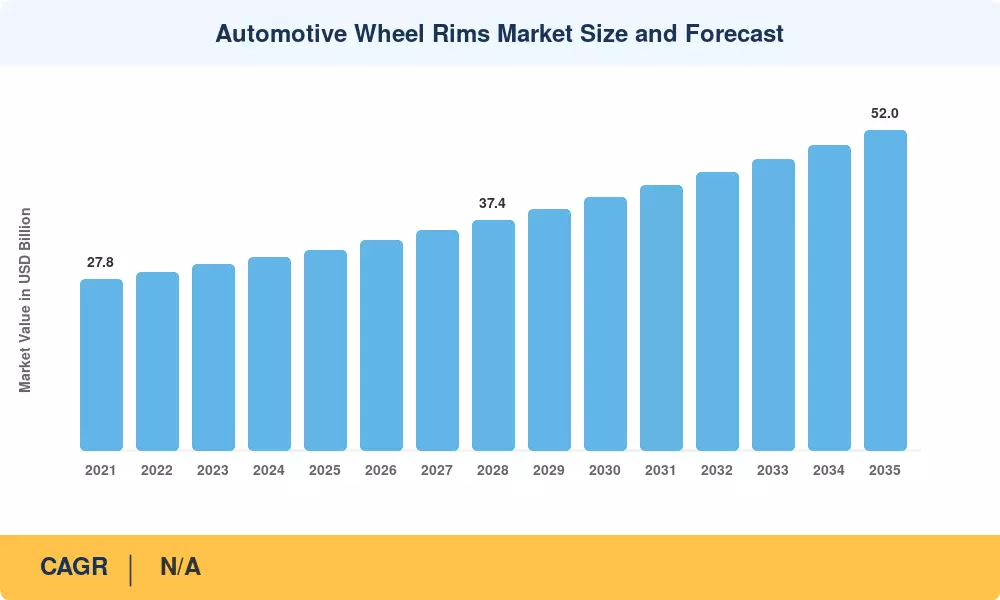
The Automotive Wheel Rims Market reached an estimated USD 32.5 billion in 2025 and is projected to grow from USD 34.1 billion in 2026.
NEW YORK, NY, UNITED STATES, July 23, 2026 /EINPresswire.com/ — The Automotive Wheel Rims Market reached an estimated USD 32.5 billion in 2025 and is projected to grow from USD 34.1 billion in 2026 to USD 52.0 billion by 2035, registering a CAGR of 4.8% during the forecast period (2026–2035).
Market Overview
Automotive wheel rims are the outer circular metal or composite structures that form the foundation of a vehicle’s wheel assembly, providing the essential support for mounting tires and connecting the wheel to the vehicle’s hub and axle. These critical components are manufactured from various materials including aluminum alloy, steel, carbon fiber reinforced polymer (CFRP), and magnesium, each offering distinct trade-offs in weight, strength, cost, and aesthetic appeal. The wheel rim serves multiple crucial functions: it supports the vehicle’s weight, transfers driving and braking forces between the tire and the road, maintains the tire’s shape and air pressure, and contributes significantly to vehicle handling, ride comfort, and overall aesthetics. With the rising trend of vehicle customization and performance enhancement, wheel rims have become a key focus of attention, with designs ranging from simple steel wheels to complex alloy and forged structures featuring intricate spoke patterns and finishes.
Two forces are driving this acceleration: tightening fuel-economy mandates across major automotive markets — the EU’s CO₂ fleet standard of 93.6 g/km effective 2025 and the U.S. CAFE target of 49 mpg by 2026 — and a surge in consumer preference for larger-diameter, aesthetically differentiated wheels that command higher per-unit revenue. Global light-vehicle production, expected to surpass 92 million units annually by 2027, provides the volume floor on which this growth rests.
A material-technology transition is reshaping the Automotive Wheel Rims Market. Traditional pressed-steel designs that dominated economy segments for decades are steadily losing ground to low-pressure die-cast and flow-formed aluminum alloy wheels, which offer a 30–40% weight reduction per corner. OEMs are specifying lightweight rims as a zero-cost compliance lever for emissions targets — every kilogram removed from unsprung mass yields disproportionate efficiency gains. Investment in alloy casting capacity exceeded USD 1.2 billion across Asia-Pacific foundries between 2022 and 2024, signaling long-term structural commitment.
Industry trends indicate a decisive shift toward larger diameter wheels, lightweight materials, and aerodynamic optimization. Aluminum alloy wheels account for an estimated 58% of global revenue in 2025, driven by OEM adoption in B- and C-segment passenger car classes. Carbon-fiber-reinforced polymer (CFRP) wheels are the fastest-growing material segment, expanding at a CAGR of 8.2% as performance and luxury OEMs integrate them into factory options. Steel wheels retain a meaningful presence in commercial-vehicle and entry-level passenger segments, valued at approximately USD 9.8 billion in 2025.
Technological developments are rapidly expanding the market’s capabilities and value proposition. Flow-forming, rotary-forging, and hybrid casting-forging processes are reducing both weight and cost simultaneously — a rare combination in automotive components. Digital-twin quality control and AI-driven die-maintenance scheduling are cutting scrap rates below 3% in leading Asian foundries. EV platforms impose unique requirements on wheel design, with aerodynamic efficiency mattering more because it directly extends range — every 1% improvement in aerodynamic drag coefficient adds approximately 3–5 km of real-world EV range. Tire-pressure monitoring system (TPMS) integration directly into rim architecture represents a new value-creation frontier, enabling sensor-ready rims that feed data to central vehicle computers.
Policy and regulatory influence on the market is substantial and growing. The European Commission’s Regulation (EU) 2023/851 mandates a 55% CO₂ reduction for new passenger cars by 2030 compared to 2021 levels, requiring OEMs to reduce weight from all subsystems. The EU’s End-of-Life Vehicles Regulation revision (2023) further incentivizes recyclable mono-material wheel designs, favoring aluminum over mixed-material constructions. The Aluminium Stewardship Initiative (ASI) certification is becoming a de facto OEM procurement requirement, with major automakers committing to sourcing at least 50% recycled aluminum for non-structural components, including wheels.
📍 Get Free Sample Report for Detailed Market Insights:
https://www.marketresearchfuture.com/sample_request/10101
Market Segmentation
By Material Type
The market is segmented by material type into Aluminum Alloy, Steel, Carbon Fiber (CFRP), and Magnesium & Others. Aluminum alloy wheels account for an estimated 58% of global revenue in 2025, led by OEM adoption in B- and C-segment passenger car classes. Low-pressure die-casting remains the most common production method, but flow-forming is gaining share for its ability to produce thinner, stronger barrel sections at competitive cost. Steel wheels retain a meaningful presence in commercial-vehicle and entry-level passenger segments, valued at approximately USD 9.8 billion. Carbon-fiber-reinforced polymer (CFRP) wheels are the fastest-growing material segment, expanding at a CAGR of 8.2% as performance and luxury OEMs integrate them into factory options. Magnesium & Others account for 8% market share, serving motorsport crossover and ultra-premium niche applications.
By Vehicle Type
Vehicle type segmentation includes Passenger Cars, Commercial Vehicles, and Two-Wheelers. Passenger cars represent the revenue backbone at 65% market share, consuming over four billion rim units globally per year when including aftermarket replacements. The shift toward SUVs and crossovers within the passenger segment is particularly meaningful: these vehicles typically require 17- to 20-inch rims versus the 14- to 16-inch range common on sedans, directly increasing average selling prices by 25–40% per set. Commercial vehicles account for USD 7.8 billion in 2025, with fleet durability requirements and retread-compatible rim specs sustaining demand. Two-wheelers grow at a 5.5% CAGR, driven by rising motorization in India and Southeast Asia.
By Sales Channel
Sales channel segmentation covers OEM and Aftermarket. OEM sales represent roughly 62% of market revenue, reflecting the growing OEM practice of offering multiple wheel-design tiers at the point of vehicle purchase. Aftermarket channels are projected to reach USD 20.3 billion by 2035, fueled by customization culture and e-commerce wheel-and-tire bundles, as digital platforms reduce friction in the fitment-selection process and allow consumers to preview wheel designs on their specific vehicle models.
By Rim Size
Rim size segmentation includes 13–15 Inch, 16–18 Inch, 19–21 Inch, and Above 21 Inch. The 16–18 inch range captures a significant portion of the market due to its popularity among various vehicle categories, including sedans and SUVs. The 19-inch and above segments are gaining traction, appealing primarily to high-performance and luxury vehicles, where consumer demand for advanced aesthetics and improved handling is increasing. This segment is also benefiting from the increasing adoption of electric vehicles, which may support larger wheel sizes.
By Region
Regional segmentation includes North America, Europe, Asia Pacific, South America, and the Middle East and Africa. Asia-Pacific leads with a 42% share, anchored by Chinese aluminum casting clusters. Europe holds the second-largest position with roughly a 28% share. North America accounts for 22% share.
🛒 You can buy this market report at:
https://www.marketresearchfuture.com/checkout?currency=one_user-USD&report_id=10101
Regional Analysis
Asia-Pacific
Asia-Pacific commands approximately 42% of global revenue, driven by China’s and India’s combined output of over 35 million passenger vehicles per year. China accounts for 52% of regional revenue, with vertically integrated aluminum wheel clusters—Zhejiang province alone hosts over 40 large-scale foundries exporting to European and North American OEMs. India is the fastest-growing country-level market globally at a 7.1% CAGR, propelled by the government’s PLI allocation of INR 25,938 crore for the auto-component sector and rapidly expanding SUV demand from first-time buyers in tier-2 and tier-3 cities. Japan contributes USD 2.1 billion, with premium OEM specification by Toyota, Honda, and Nissan. South Korea accounts for 8% of regional share, with Hyundai-Kia platform standardization. The Rest of Asia-Pacific grows at a 6.4% CAGR, with ASEAN vehicle-production corridors in Thailand and Indonesia.
Europe
Europe holds the second-largest position with roughly a 28% share, supported by premium OEM specification trends in Germany and Italy. Germany leads regional demand at 32% of European share, with BMW, Mercedes-Benz, and VW premium wheel programs routinely offering three to five wheel-design options per model, each carrying margin uplift of EUR 400–1,200 per set at the configurator stage. France contributes USD 1.5 billion, with Renault-Stellantis volume and Michelin-integrated fitment. The United Kingdom grows at a 4.4% CAGR, with EV incentive-driven alloy adoption. Italy accounts for 14% of regional share, with luxury/supercar OEM heritage and aftermarket design culture. The EU’s End-of-Life Vehicles Regulation revision (2023) further incentivizes recyclable mono-material wheel designs.
North America
North America — at 22% share — is the third-largest region but benefits from the highest aftermarket spend per vehicle. The United States accounts for 78% of regional revenue, with CAFE standards, robust aftermarket spending, and truck/SUV dominance. Full-size trucks and SUVs, which account for over 60% of U.S. new-vehicle sales, increasingly ship with 20-inch-plus alloy wheels as standard equipment—a specification trend that inflates average selling prices. Canada grows at a 4.0% CAGR, with aligned federal emissions targets and cold-weather wheel demand. Mexico contributes USD 0.7 billion, with nearshoring of OEM assembly and export-oriented foundries.
South America
South America represents a growing market, with Brazil accounting for 68% of regional share. Brazil’s Rota 2030 industrial policy offers tax incentives for automakers that meet energy-efficiency benchmarks, indirectly promoting alloy wheel adoption as a weight-reduction strategy. Argentina grows at a 4.5% CAGR, with CKD assembly growth. The Rest of South America accounts for USD 0.25 billion, with import-dependent replacement demand.
Middle East & Africa
The Middle East & Africa region, valued at USD 1.30 billion in 2025, is small in absolute terms but growing steadily. Saudi Arabia accounts for 30% of regional revenue, with Vision 2030 automotive localization target of localizing 50% of vehicle value-added content by 2030. The UAE grows at a 5.0% CAGR, with luxury-vehicle density and aftermarket culture. South Africa contributes USD 0.28 billion, serving as a regional assembly hub for Toyota and BMW.
Competitive Landscape / Key Players
The Automotive Wheel Rims Market is moderately fragmented, with the top five players collectively controlling approximately 30–35% of global revenue. Key companies operating in this market include Citic Dicastal (~7–10% share), Maxion Wheels (~5–8%), Superior Industries (~4–6%), Ronal Group (~3–5%), Enkei Corporation (~3–5%), Arconic (Howmet) (~2–4%), BBS GmbH (~1–3%), Borbet GmbH (~2–4%), Iochpe-Maxion (~2–3%), and Wanfeng Auto Holding (~2–4%).
Strategic developments in the market include significant capacity expansions. In January 2026, Maxion Wheels announced forged-aluminum truck wheel production will begin at its new plant in Manisa, Turkey. In June 2025, Uno Minda opened a greenfield alloy-wheel facility in Kharkhoda, Haryana, to meet increased premium-wheel demand from Indian OEMs.
Competitive differentiation increasingly hinges on lightweighting technology, advanced manufacturing processes, and sustainability credentials. Competition occurs along two axes: cost-driven scale in OEM supply and brand-driven differentiation in aftermarket channels. Regional specialists coexist with global players, and vertical integration—from aluminum smelting to finished wheel—is a growing competitive moat.
Latest Industry News & Developments
Recent industry developments highlight the ongoing transformation of the automotive wheel rims market toward lightweighting, sustainability, and capacity expansion. In January 2026, Maxion Wheels announced forged-aluminum truck wheel production will begin at its new plant in Manisa, Turkey, reflecting the growing demand for lightweight commercial vehicle wheels.
In June 2025, Uno Minda opened a greenfield alloy-wheel facility in Kharkhoda, Haryana, to meet increased premium-wheel demand from Indian OEMs. This investment reflects the rapid growth of India’s automotive market and the shift toward alloy wheels in the passenger vehicle segment.
In June 2025, Uno Minda opened a greenfield alloy-wheel facility in Kharkhoda, Haryana, to meet increased premium-wheel demand from Indian OEMs. The industry is also witnessing a growing focus on aero-optimized wheels for electric vehicles, with wheel designs that improve aerodynamic efficiency directly extending EV range.
Market Challenges & Opportunities
Key restraints facing the automotive wheel rims market include aluminum price volatility, with LME aluminum prices fluctuating between USD 2,100 and USD 2,800 per metric tonne from 2023 to 2024, causing margin instability for wheel producers. Counterfeit and sub-specification imports, accounting for 8-12% of aftermarket unit sales in price-sensitive regions, reduce branded producers’ pricing power. Extended vehicle replacement cycles and high tooling costs for new designs further constrain growth.
Emerging opportunities in the market are substantial and diverse. Aero-optimized wheels for battery-electric vehicles present a significant opportunity, with wheel designs incorporating partial covers, flat-spoke geometries, and integrated air-channeling features offering a premium-pricing opportunity. Recycled-aluminum circular economy enables wheel manufacturers to establish closed-loop recycling partnerships, locking in raw-material cost advantages of 15–20% versus primary aluminum while meeting OEM sustainability-scorecard requirements. Direct-to-consumer aftermarket platforms, with e-commerce penetration in the wheel-and-tire aftermarket remaining below 15% globally, present addressable whitespace for digitally native brands.
Future potential lies in emerging-market premiumization, with India’s passenger-vehicle market expected to cross 5.5 million units annually by 2028, and SUV share exceeding 55%, substantially increasing per-vehicle wheel-rim revenue. Smart-wheel and sensor-integrated rims, with TPMS integration directly into rim architecture alongside embedded accelerometers for road-surface analytics, represent a new value-creation frontier, enabling subscription-based services around predictive maintenance. Advanced manufacturing and Industry 4.0 adoption, including digital-twin quality control and AI-driven die-maintenance scheduling, are cutting scrap rates below 3% in leading foundries. Sustainability and circular-material supply chains will reward manufacturers with closed-loop scrap-recovery systems and penalize those reliant on primary smelter supply.
To explore more market insights, visit us at:
https://www.marketresearchfuture.com/reports/automotive-wheel-rims-market-10101
Final Market Summary
The automotive wheel rims market is positioned for strong growth through 2035, driven by vehicle lightweighting mandates, rising global vehicle production, EV platform-specific wheel demand, and aftermarket customization culture. The projected valuation of USD 52.0 billion reflects rapidly expanding adoption across all material types and vehicle segments, with the market transitioning from traditional pressed-steel designs toward aluminum alloy, flow-formed, and carbon fiber solutions.
The medium-term growth outlook remains positive, with the market registering a CAGR of 4.8% during the forecast period. Asia-Pacific will continue to lead market expansion through China’s manufacturing dominance and India’s premiumization, while Europe maintains a strong position through premium OEM demand and regulatory-driven lightweighting. The ongoing development of aero-optimized EV wheels, recycled-aluminum circular economy models, and smart-wheel sensor integration will continue to expand market possibilities and applications.
Long-term industry potential extends beyond the current forecast horizon. The global EV fleet, projected to exceed 250 million vehicles by 2030, presents unique wheel-design constraints and premium pricing opportunities. Advanced manufacturing processes will reduce both weight and cost simultaneously, with digital-twin quality control cutting scrap rates below 3%. Sustainability and circular-material supply chains, with the Aluminium Stewardship Initiative certification becoming a de facto OEM procurement requirement, will reward manufacturers with closed-loop scrap-recovery systems. Smart-wheel and sensor-integrated rims will create a new value-creation frontier, enabling subscription-based services around predictive maintenance. Manufacturers that successfully develop lightweight, aero-optimized wheel solutions, invest in advanced manufacturing and circular economy models, and adapt to evolving EV requirements will capture substantial value in this evolving market. The transformation of wheel rims from simple structural components to technologically advanced, sustainable, and sensor-enabled elements of vehicle performance represents a fundamental advancement in automotive engineering, enabling the next generation of efficient, electrified, and connected mobility.
More Related Reports from MRFR Library:
Automotive Cylinder Liner Market: https://www.marketresearchfuture.com/reports/automotive-cylinder-liner-market-31297
Automotive Emc Market: https://www.marketresearchfuture.com/reports/automotive-emc-market-31303
Automotive Rebuilt Engines Market: https://www.marketresearchfuture.com/reports/automotive-rebuilt-engines-market-31388
Automotive Remanufacturing Market: https://www.marketresearchfuture.com/reports/automotive-remanufacturing-market-31389
Used Ev Market: https://www.marketresearchfuture.com/reports/used-ev-market-31422
Driver Monitoring System Market: https://www.marketresearchfuture.com/reports/driver-monitoring-system-market-31505
Autonomous Logistics Vehicle Market: https://www.marketresearchfuture.com/reports/autonomous-logistics-vehicle-market-31984
Second Life Battery Market: https://www.marketresearchfuture.com/reports/second-life-battery-market-32233
Hydrogen Fuel Cell Train Market: https://www.marketresearchfuture.com/reports/hydrogen-fuel-cell-train-market-32242
Electric Oil Pump Market: https://www.marketresearchfuture.com/reports/electric-oil-pump-market-32256
Larry Wilson
WantStats Research And Media Pvt. Ltd.
+1 855-661-4441
email us here
Legal Disclaimer:
EIN Presswire provides this news content “as is” without warranty of any kind. We do not accept any responsibility or liability
for the accuracy, content, images, videos, licenses, completeness, legality, or reliability of the information contained in this
article. If you have any complaints or copyright issues related to this article, kindly contact the author above.

Media gallery